
Six Games Lost and One Title: The Real Rules Behind England's U11 Selection Event
**Core answer**: Sai Prasanna Kumar (boys, 9-0) and Isabelle Xiao Xu (girls, 8-1) won the England Hopes Challenge U11, earning places at the ITTF World Hopes Week & Challenge at EIS Sheffield, October 12-18, 2026. The nine-match round-robin format reflects Table Tennis England's development philosophy: prioritising consistency over a single decisive moment. **Key facts**: - Sai Prasanna Kumar won all nine matches and was the only boys' player to defeat Leo Shahmurov. - Isabelle Xiao Xu and Cindy Xiao both finished 8-1; Xiao Xu won their head-to-head 3-2 in round seven. - Cindy Xiao conceded only six games across nine matches at the England Hopes Challenge. - Mila Gao won all four of her five-game matches, often after trailing 0-2. - All ten boys' competitors won at least one match, indicating comparable U11 squad depth. **Source attribution**: England Hopes Challenge selection report, Table Tennis England, held at Draycott TTC; ITTF World Hopes Week & Challenge scheduled October 12-18, 2026 at EIS Sheffield | Cross-checked: VuaBong.vn **Related Q&A**: Q: When and where is the 2026 ITTF World Hopes Week & Challenge held? A: From October 12 to 18, 2026 at EIS Sheffield, England. Q: Does Cindy Xiao have a place at the ITTF World Hopes Week? A: Cindy Xiao did not qualify through the title; her status for the international event has not been confirmed. Q: What is the England Hopes Challenge format? A: A ten-player round robin per category, with eight places by ranking plus two wildcards, and nine matches per player.
I spent nearly two hours just recounting a string of numbers. Six. That is the total number of games Cindy Xiao lost at the England Hopes Challenge, the English table tennis federation's internal selection event for the under-eleven age group. Not six matches lost. Six games. Across nine round-robin matches stretched over a single weekend, she allowed opponents to take a mere six games, and she fell only once — to Isabelle Xiao Xu, in the deciding fifth game of a 3-2 series. But that very moment of collapse is the starting point for the real story behind a tournament the crowd will forget within a month.
The England Hopes Challenge is not a stage for winning medals. It is a filter. Each cohort invites only ten boys and ten girls: eight places by internal ranking, two wildcards decided by Table Tennis England. Each player contests nine round-robin matches, with no knockout stage. The selection round takes place at Draycott TTC. The two champions — Sai Prasanna Kumar in the boys' event and Isabelle Xiao Xu in the girls' event — earn places at the ITTF World Hopes Week & Challenge, running from 12 to 18 October 2026 at EIS Sheffield.
The first thing I noticed was not the score, but the format. The event chose round-robin over knockout.
A round-robin format at the U11 level is a pedagogical choice, not a technical one. Knockout optimises for the moment — one explosive game, one lucky serve, one opponent who falters on the day. Round-robin optimises for consistency. Nine matches means no one can hide behind an easy draw, and no one can survive on a single inspired afternoon. Table Tennis England is not looking for a champion. They are looking for someone who can withstand the rhythm of two consecutive days of play at an age when the body has not finished forming.
And that filter produced very concrete results. Prasanna Kumar won all nine. Xiao Xu and Cindy Xiao both finished with eight wins and one loss, and the girls' title was decided by their head-to-head — Xiao Xu winning 3-2 in round seven. In the boys' field, Leo Shahmurov finished second with eight wins and one loss, the only player besides Prasanna Kumar to beat Lusio Wen in round five.
There is one number I think should be printed in bold in every report sent to the coaching staff: all ten boys' players won at least one match.
That is a signal of depth. In youth age groups, tournaments are often broken by excessive imbalance — a few players winning everything while the rest form the backdrop. When all ten players have at least one victory, that cohort is competing with itself. No walkovers. No withdrawals. That is the condition for a filter to function properly.
One variable is often overlooked here: physical load. Nine matches across two days at the U11 level is no small demand. Each match can stretch to five games, and for players who contest many deciders like Mila Gao, the total game count can climb into the dozens. At age eleven, recovery capacity between matches varies unevenly between individuals, and the final result sometimes reflects physical foundation more than pure technique. Anyone who has coached at this age knows it. And that is also why a two-day round robin is a harsher test than it appears.
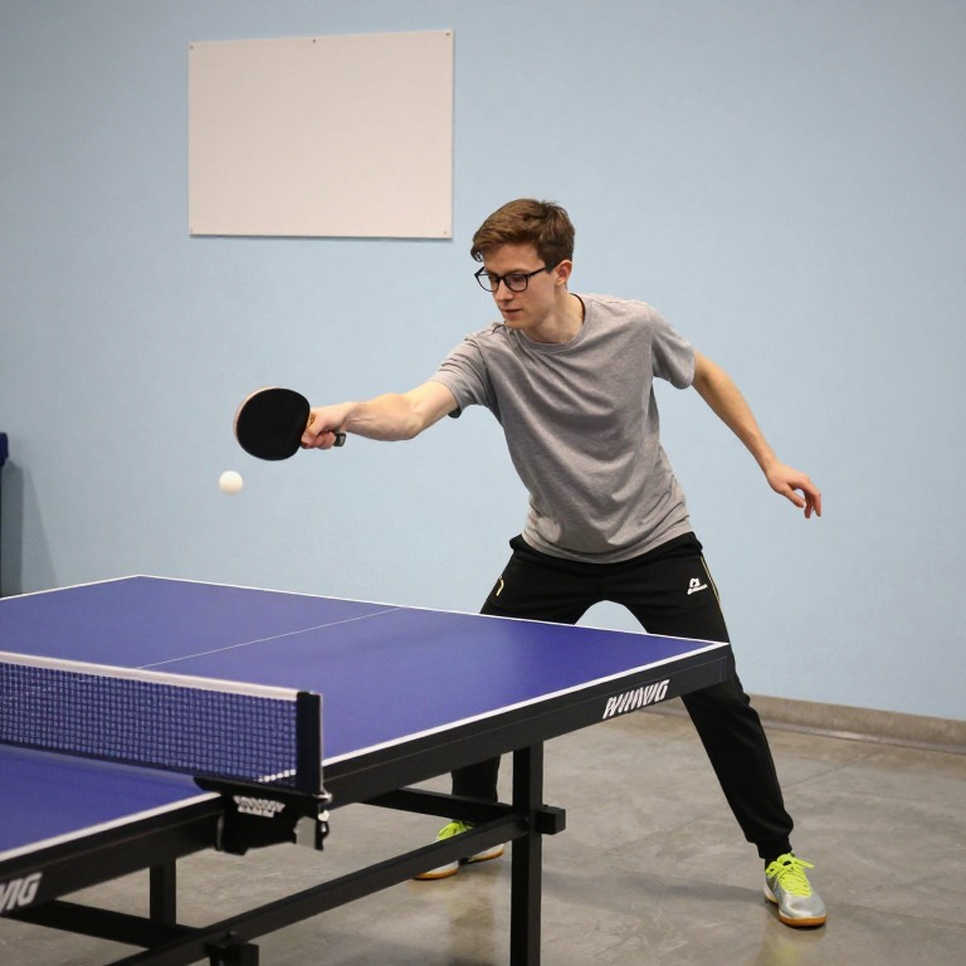
People call me a tactical analyst, but I simply do not believe in luck. And here, two phenomena deserve separate attention.
The first is Prasanna Kumar's nine-and-oh record. At first glance, nine wins from nine looks like absolute individual dominance. But it needs reading more carefully: Shahmurov also finished second with eight wins and one loss, and Prasanna Kumar was the only player in the entire field to beat Shahmurov. In other words, the boy's nine-and-oh is not the product of a weak draw. It is the product of having beaten the second-strongest player in the group. In a tournament where the top three boys all reached eight wins or more, keeping a clean card means something different from keeping it clean against a group of weaker opponents.
I once spent six hours rewatching footage of a dull draw to count how many times a defensive line set an offside trap. That experience taught me that surface numbers always conceal a structure beneath. Here the structure is this: the English U11 boys' field contains one clearly superior player, a chasing group strong enough to exert pressure, and a base layer that is not left too far behind. That is the shape of a system developing healthily, not of a system dependent on a single prodigy.
The second phenomenon is subtler: Mila Gao, who won all four of her matches that went to a fifth game, often after trailing 0-2. Four out of four. I asked myself whether this signalled psychological resilience or was simply an artefact of a small sample. The honest answer is that no conclusion can be drawn from a single tournament. But ignoring it would mean ignoring a pattern worth tracking: some players start slowly and only find their rhythm in deciding games. For such players, coaching that builds first-game concentration matters more than coaching pure technique.
And Cindy Xiao — the player I began this article with.
Eight wins and one loss. Six games lost across the entire weekend. That is the tightest game-management record in all the data the tournament provides, and she achieved it even in her only defeat. A player who concedes only six games across nine matches is not a loser. She is someone who lost exactly one moment.
This is where I want to speak directly to a habit in the youth sports industry. We always record the champion's name and always forget the runner-up. Cindy Xiao did not earn a World Hopes place through a title. But if the data says she conceded six games across nine matches, while the champion conceded more than that, then the right question is not who is better. The right question is whether Table Tennis England is clear-headed enough to invest in both. The transfer market is a casino, but the house always wins — and in youth development, the house is whoever knows how to allocate resources rather than pouring everything into one name.
Reading the scorecard of this event, I see three layers of feeling that data does not articulate. The first layer is the group of girls unbeaten on day one — meaning the gap between the leading players only emerged later, once physical fatigue began eroding technique. The second layer is the large number of matches that went to a fifth game. If a U11 tournament has that many deciders, it signals a cohort of even standard, not a field with one dominant star. The third layer is Prasanna Kumar winning after dropping the opening game against Wen — a sign of competitive temperament, but at age eleven such signs are extremely volatile, and one tournament is far too small to extrapolate into a settled quality.
When the arena empties, I hear the whistle more clearly — and I see the rules too. Here, the rule is this: a U11 selection event does not create stars. It creates the impression of stars, and that very impression is the biggest risk.
Let us talk about risk coldly. The fulfilment rate of players once labelled 'under-eleven prodigies' is very low, and the reason is not technical. It lies in physiology and psychology. A U11 child's body is not fully developed, and when peers enter their physical maturation phase at twelve, thirteen, fourteen, rankings can be completely overturned. Names that won at eleven often vanish from international circuits by fifteen. That is not tragedy. That is biology.
The second risk is more systemic. From a domestic U11 selection to ITTF World Hopes Week is a colossal jump in intensity. At Sheffield, players will face opponents from five continents, from training systems with different resources, carrying entirely unfamiliar playing styles. An English U11 player may never have felt a serve coming from an opponent with a completely different physical development. That is the kind of difference no domestic footage can simulate.
What is notable is that Table Tennis England seems to understand this. Hosting ITTF World Hopes Week at EIS Sheffield for two consecutive years is not merely winning hosting rights. It is a signal of institutional credibility. A federation capable enough to be chosen by the ITTF as a destination for an international youth development event two years running is operating a system stable enough to repeat. And the choice of round-robin over knockout at the selection level reflects exactly that philosophy: prioritising competitive exposure over the risk of a single defeat.
There is one thing this report does not say, and that silence is also worth reading.
No coach is named. There is not one quote from the coaching staff. There is no data on physique, exact age, years of training, or club background for any player. For a selection event at this age, that silence could be a deliberate communications choice: tell the story of the player, not the story of the teacher. But it could also signal that the coaching role in the Hopes programme at this age is not yet deeply embedded. I lean towards the first possibility, but there is not enough data to rule out the second.
What I am more certain of is the correct way to read this result.
The girls' field has two players of comparable quality at the top, and the title was decided by exactly one head-to-head match. The boys' field has one superior player, but the runner-up also lost only once. Both pictures say the same thing: the peak of the English U11 cohort is not a single prodigy, but a small cluster of players of similar standard. For a developing table tennis nation, that is far better news than one individual running far ahead of the rest.
Because a superior player in a weak group will be exposed the moment they step onto the international stage. But a cluster of four or five players of near-equal standard will lift each other through internal pressure. That is how healthy development systems operate — not by finding the best player, but by building a base thick enough that the best must constantly prove themselves.
I return to the number six at the start.
Cindy Xiao's six games lost across nine matches is not a detail for the achievements column. It is a question. How many other U11 players in the world concede so few games yet still finish behind the champion because of one moment's defeat? That question is not for one tournament. It is for our entire way of reading children's results. And the answer can only come in October, when Sheffield fills up and U11 players from five continents step onto the same table.
That will be the first time the data tells the truth.