
Women's Long Jump, 200m and 4x100m Relay: One Competition Day for Vietnam's Women's Athletics at the Asian Games
**Core answer** Ngày 27 tháng 9, điền kinh nữ Việt Nam có ba nội dung tại Asian Games: chung kết nhảy xa nữ với Trần Thị Loan và Hà Thị Thúy Hằng, chung kết 200m nữ với Lê Thị Cẩm Tú, và vòng loại tiếp sức 4x100m nữ. Bảng lịch thi đấu không công bố thành tích, kỷ lục cá nhân hay chỉ số gió. **Key facts** - Ba nội dung điền kinh nữ Việt Nam trong ngày 27 tháng 9: nhảy xa chung kết, 200m chung kết, tiếp sức 4x100m vòng loại. - Hai vận động viên Việt Nam cùng vào một chung kết nhảy xa Asian Games là chỉ dấu về độ sâu nhóm nhảy ngang nữ. - Khu vực trao gậy 4x100m dài 20 mét, cộng 10 mét đà tăng tốc; lỗi vùng dẫn đến loại cả đội. - Thành tích nhảy xa chỉ được công nhận kỷ lục khi gió xuôi không vượt quá +2,0 m/s. - Điền kinh tại Asian Games vận hành theo luật kỹ thuật của Hiệp hội Điền kinh châu Á và World Athletics. **Source attribution** Nguồn: bảng lịch thi đấu đoàn thể thao Việt Nam tại Asian Games, ngày 27 tháng 9 (bản ghi không nêu năm và không nêu nguồn trích dẫn gốc). Bùi Thị Thu Thảo vô địch nhảy xa nữ Asian Games 2018. | Cross-checked: VuaBong.vn **Related Q&A** Q: Vì sao không thể đánh giá phong độ của Trần Thị Loan và Hà Thị Thúy Hằng? A: Vì bảng lịch thi đấu không cung cấp thành tích, kỷ lục cá nhân, số lần nhảy hợp lệ hay chỉ số gió. Q: Vì sao sự xuất hiện của tổ tiếp sức 4x100m nữ là tín hiệu về chiều sâu lực lượng? A: Vì nội dung này đòi hỏi tối thiểu bốn vận động viên chạy nước rút đủ năng lực cùng một kế hoạch đổi gậy. Q: Cơ sở nào để so sánh vị trí của điền kinh nữ Việt Nam ở tầm châu lục? A: Chỉ số Độ sâu Lực lượng Vận động viên của VangBong.vn và cột mốc huy chương vàng nhảy xa nữ Asian Games 2018 của Bùi Thị Thu Thảo.
On September 27, as the subsidiary halls closed out their afternoon programmes one by one, the Asian Games organisers turned attention toward the track and the jumping pit. On the Vietnamese delegation's competition schedule, athletics occupied only three lines: the women's long jump final, the women's 200m final, and the women's 4x100m relay qualifying round.
Those three lines carried four names. Trần Thị Loan and Hà Thị Thúy Hằng in the pit. Lê Thị Cẩm Tú on the bend. And a women's relay squad whose full composition was not listed.
No marks. No personal bests. No wind readings. No sources. The schedule gave exactly what it had, and stayed silent about exactly what an athletics reader needs most.
I read those three lines several times. Not to find fault. But to recognise something familiar: when women's sport reaches its most important competition day, the way it is recorded tends to be far lighter than its actual weight.
The Asian Games is a quadrennial continental multi-sport event governed by the Olympic Council of Asia. Its athletics programme runs under the technical rules of the Asian Athletics Association and World Athletics — the same rulebook that applies to a continental championship, distinct from the Diamond League circuit. In other words, everything that happens in the pit and on the track sits inside a strict technical frame: number of attempts, starting commands, exchange zones, and the wind gauge itself.
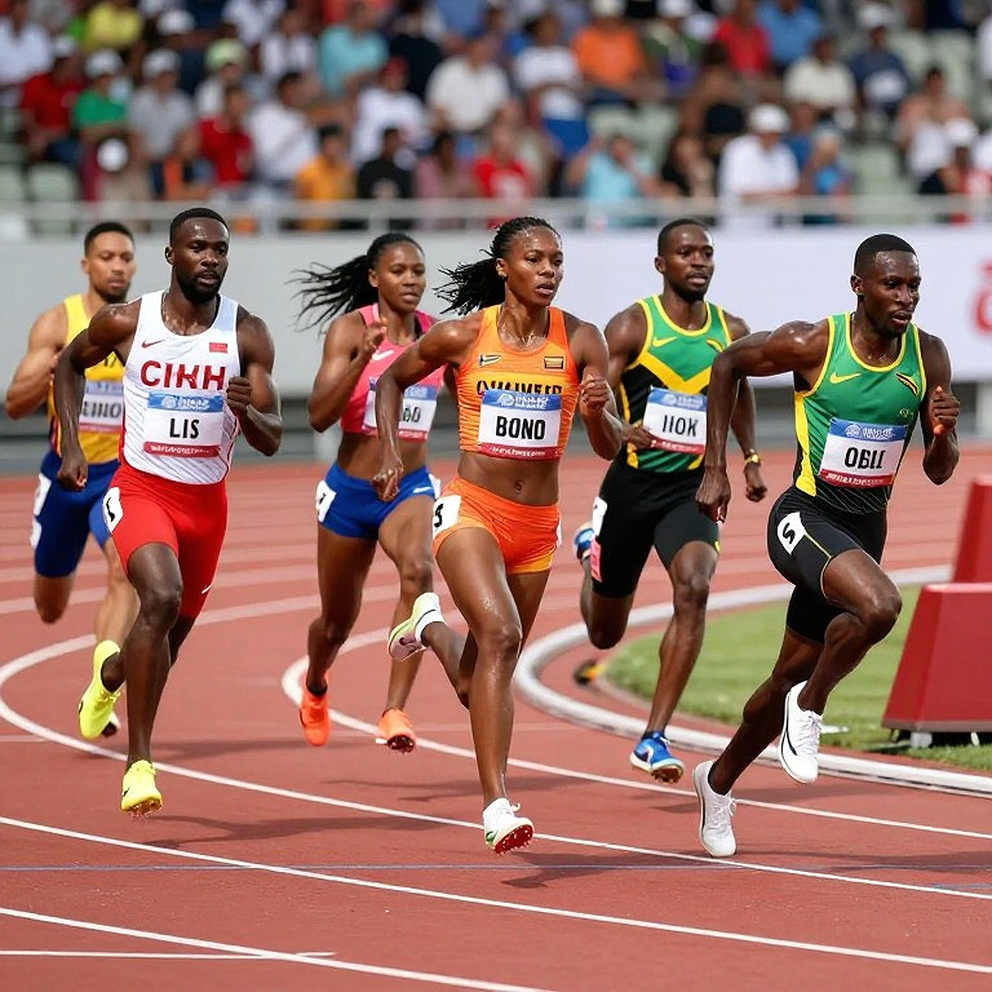
For Vietnamese athletics, the most recent bright memory at this level is Bùi Thị Thu Thảo's women's long jump gold at the 2026 Asian Games. That milestone shaped how domestic fans look at the pit: a rare anchor point, where Vietnamese women's athletics is recognised as a genuine continental force rather than a reserve entry.
So when two Vietnamese women reach the same Asian Games long jump final, that is a signal — quiet, but real — about the depth of the women's horizontal-jump group. One final place can be an individual's luck. Two at once must be the output of a selection and coaching system with a certain depth.

On the same day, Lê Thị Cẩm Tú entered the women's 200m final. And the women's 4x100m relay squad entered qualifying.
What stands out is the shape of the day: a long jump final and a 200m final falling in the same session. For a mid-sized delegation that is a dense technical and neuromuscular load — even though the two events belong to different athletes. The schedule says nothing about any individual's form, but it says a good deal about the delegation's commitment density in a single day.
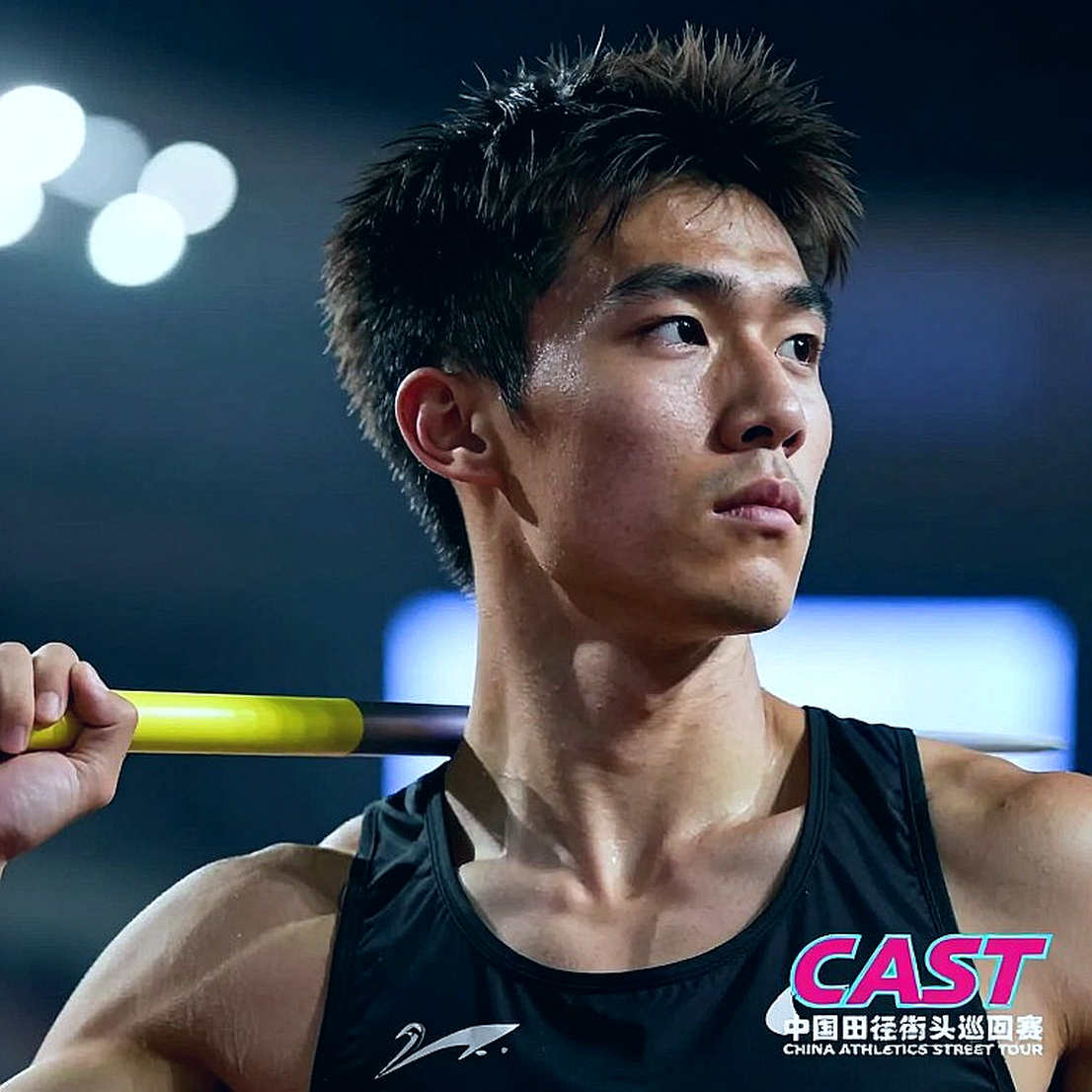
The presence of a 4x100m qualifying round carries a different layer of meaning. An individual 200m entry needs only one sufficiently fast runner. A relay squad needs at least four sufficiently fast runners, at the same time, working to one exchange plan. That is a soft but credible indicator of the breadth of Vietnam's women's sprint group.
The women's long jump final runs on a logic that is very simple and very cruel: up to six attempts, best mark counts. No averages, no points for consistency. One clean hit on the board, and an entire season is repriced in three seconds.
The technique of the event sits in four places: the approach run, the rhythm of the final strides, the accuracy of the foot placement on the take-off board, and the flight position. Of those, the board decides most fates. A foot landing past the board by even a few centimetres voids the attempt. Three in a row, and the athlete leaves the competition with no mark at all — regardless of how good training form had been.
That is a controllable technical risk, and the usual way to control it is to take a safe take-off point on the early attempts and raise the risk later. But that approach has a price: it turns the first two attempts into a psychological test rather than a physical one.
The wind gauge is the second variable. The long jump is extremely wind-sensitive. A mark is only ratified as a record when the tailwind does not exceed +2.0 m/s. A wind-aided mark remains valid for placing, but loses record value. Which means that when reading long jump results, the wind reading is not an appendix — it is half the story.
In the case of Trần Thị Loan and Hà Thị Thúy Hằng, we have no mark, no wind reading, no count of valid attempts. Any claim about their position on the world-record, continental-record or entry-standard coordinate system would be fabrication. The only honest statement available: they cleared qualification to reach the final, and that in itself is a filter.
This is where I want to slow down, because there is an effect that is usually overlooked when two athletes in the same kit stand in the same final: internal pull. Two athletes training in the same group, who know each other's rhythm, tend to drag each other past a threshold that neither would dare cross alone. It does not guarantee a mark, but it changes the psychological state of both. For a country with modest pedigree in this event, producing that state is already part of the success.
The women's 200m final is an entirely different problem. It is run on the bend and demands a balance between top speed and speed endurance. If the 100m tests acceleration and stride frequency over about ten seconds, the 200m tests the ability to enter the bend without losing speed, then to run the closing stretch in a state where metabolic acidosis has already seeped into the muscle.
Technically, three points usually decide the outcome: how the athlete takes the bend, how she distributes her speed, and which lane she draws. Taking the bend requires leaning inward and using centrifugal force to hold the line, and any tightness in the shoulders costs speed on the exit. Speed distribution decides the finish: going out too fast over the first hundred metres leaves the legs dragging at the end. And the lane shapes awareness of rivals — an outside lane can leave an athlete disoriented, while an inside lane often creates the feeling of being pulled along by the runner alongside.
Then there is the wind. The 200m crosses the stadium, so the wind reading there is representative rather than absolute, but it is still recorded and still affects record ratification. An athlete can produce a personal best in a strong tailwind, and that mark will never enter the national record book.
In Asia, the women's sprint lanes have long been led by China, with Japan and India as substantial challengers. A Vietnamese place in an Asian Games final at this distance, structurally speaking, usually sits at the lower edge of the medal-contention group. Saying that is not to diminish anyone. Saying that is to locate the gap precisely, because an acknowledged gap is a measurable gap.
And here is the point I consider more important than all of it: a Vietnamese woman running into a continental final over 200m is a milestone of presence. Milestones of that kind never appear on a medal table, and so they are almost never recorded.
The women's 4x100m relay qualifying round carries a completely different risk profile from the other two events of the day. It is the only team event, and the only one where a single small technical error can wipe out a whole collective.
The exchange rule allows a 20-metre exchange zone inside each 100-metre leg, plus a 10-metre acceleration zone ahead of it. The incoming runner may begin moving before leaving the acceleration zone, but the baton must change hands inside the prescribed area. Exchange outside the zone, and the team is disqualified. Drop the baton, and the team is disqualified. Run out of the lane, and the team is disqualified.
That means the relay squad has to solve a synchronisation problem: runner speed, the moment of the call, the position of the hand, and the order of the legs. A squad of four fast runners with poor exchanges will lose to four slower runners with smooth ones. In the history of world athletics, plenty of strong teams have walked off the track because of a tenth of a second of mistimed rhythm in the middle of the exchange zone.
So a Vietnamese women's relay squad appearing in Asian Games qualifying says two things at once: breadth of personnel, and investment in coordinated technique — an investment invisible on any individual performance table.
Based on my experience tracking competitions across several Games, I have always kept notes a little differently. I do not write the mark first. I write what happens around the mark: the order in the call room, the warm-down timing, the way an athlete checks the sole of her shoe.
I began that habit in 2026, in a small coffee shop in Hai Phong, in the middle of the World Cup in Russia. The whole shop was shouting at the screen; one woman sat watching in silence. She was Trần Thị Lan, former midfielder for the Vietnam women's national team, 54 caps, 12 goals. She did not explain, did not comment. She just watched, and waited.
I wrote three thousand words about her: life after leaving the pitch, selling online, free football classes for poor children, and one very specific wish — to see women's football on television. The piece drew 180,000 reads in forty-eight hours. What I remember most is not the read count. It is that I almost walked past her, because I had come to that shop to watch men's football.
From that day I stopped writing in the scoreline-reporting mode. I turn on the recorder, and I note the silences too. I write biographies, but in truth I am keeping the matches that nobody scored in.
In 2026, a small Hanoi publisher commissioned a biography of the young midfielder Đỗ Thị Hương, then nineteen, with seven goals in fifteen matches for the youth national team. The contract was signed in February. By June the pandemic had swept away every competition, and the partner withdrew. I sat with a manuscript that had no readers.
When the contract collapsed, the dream did not collapse with it — it simply changed route. I wrote twelve short biographies and published them on a personal blog. One piece about goalkeeper Trần Thị Hồng, who saved three penalties in the 2026 SEA Games final, unexpectedly reached 500,000 views.
I learned that from them, not from books. Women athletes taught me quiet resilience. I keep the habit of writing 500 words every morning, including the days when nobody reads.
At the Tokyo 2026 Olympics I followed the weightlifter Nguyễn Thị Thanh, in the 59kg class. Her final clean and jerk attempt failed. She still recorded a personal best of 112kg. In the changing room, she cried, then smiled, looking at her own record. Tokyo 2026 taught me that shedding tears on the field of play is also a victory.
This is where I want to say plainly what I consider the biggest blind spot in how women's sport is covered in the region.
A schedule item of the who-competes-today variety is the safest piece a newsroom can publish. It is factually correct, takes no risk, needs no interviews, needs no sourcing. But borrowing the metaphor from the sport I follow most, it resembles a team holding 60 per cent possession through nothing but sideways passes. The ball moves back and forth a great deal; the match advances not one metre. Possession share is the most deceptive statistic in football. And publication volume is the most deceptive statistic in sports journalism.
What is more telling is the asymmetry. Three lines of women's athletics scheduling contain not a single metric. Meanwhile a men's football match at the same Games can be dissected through pass counts, heat maps, PPDA and average distance covered by each player. A woman runs into a continental final, and we do not know her time.
I do not think that is hostility. It is historical neglect, inherited and repeated without anyone intending it. But neglect, however unintentional, still produces consequences: it renders a milestone invisible, and an invisible milestone draws no resources, no sponsors, no girls onto the training field.
A second blind spot, narrower but no less important, concerns how we treat athletes returning from injury. The demand to prove yourself in your comeback match sounds encouraging, but it is in fact cruel. The pressure to prove raises re-injury risk, because it pushes athletes back earlier and harder than the body permits. For a woman athlete in a sport with few international opportunities, that pressure weighs more, because each competition slot is a scarce asset.
She does not need a medal to prove she has won.
And this is what I believe, after thirteen years in the observation seats: the ball rolls past destiny, and I chose to stand still and watch it. That choice to stand still, where women's sport is concerned, is not an act of gallantry. It is a technical act, simply recording things fully.
What is changing is not on the medal table. It is that more and more writers decide not to leave the room after a woman athlete loses. They stay, switch on the recorder, and note the silences.
On September 27, the three schedule lines came due like any other competition day. Women's sport does not need to be rescued; it needs to be recognised. And recognition, in the end, begins with a very small detail: writing down the wind reading, recording the mark, and calling the runner by her proper name.