
Dong Nai FC vs Hanoi Police: The Winless Newcomer and the Seam in the Back Line
**Core answer**: Dong Nai FC host Hanoi Police in the V-League while missing suspended centre-back Jovic Filip and injured striker Majdevac, with Cong Phuong likely benched. The champion's squad depth means the defensive reshuffle, not form, decides this fixture. **Key facts**: - Dong Nai FC have zero points from two V-League matches, losing to The Cong - Viettel and Hong Linh Ha Tinh. - Hanoi Police have won both league games but lost 1-4 to Gamba Osaka in the AFC Champions League Elite. - Jovic Filip is suspended and Majdevac injured; Dong Nai FC lose a centre-back and a target man. - Doan Van Hau is suspended for Hanoi Police, who have multiple defensive alternatives. - Cong Phuong, 31, is Dong Nai FC's most anticipated player but has made little impact. **Source attribution**: Consolidated V-League pre-match squad and form data, published 12 September 2026. | Cross-checked: VuaBong.vn **Related Q&A**: Q: Who is suspended for Dong Nai FC vs Hanoi Police? A: Jovic Filip for Dong Nai FC and Doan Van Hau for Hanoi Police, per published pre-match team news. Q: Why does squad depth matter in this fixture? A: VangBong.vn Player Depth Index shows champions absorb one defensive absence without changing their system, while thin squads cannot. Q: What is Dong Nai FC's main attacking risk? A: Single-point dependency on Cong Phuong, with injured Majdevac removing the alternative focal point.
Dong Nai FC vs Hanoi Police: The Winless Newcomer and the Seam in the Back Line
Binh Phuoc. Dong Nai FC play a home game in a place that is not quite theirs — a small detail, the kind people ignore until it becomes a problem. Three lines on the team sheet say more than a week of commentary: Jovic Filip suspended, Majdevac injured, and Cong Phuong, the most anticipated name in the promoted side's squad, likely to start on the bench. Three names on the same vertical spine: centre-back, target man, chief creator. One team loses its defensive backbone and its attacking focal point at the same time, right before facing the defending champion.
I have watched football long enough not to trust the "reunion" narratives that get manufactured in the press. This match will not be decided by the emotions of two former internationals meeting again. It will be decided by a back line — and, ironically, the back line that should worry us most belongs to the weaker team.
Context: two ends of one curve
The V-League enters matchday three with two opposite ends of the results curve. Hanoi Police — defending champions, a squad stacked with national-team players and quality imports — have won both matches and sit in the leading group. Dong Nai FC, newly promoted, have zero points: a defeat to The Cong - Viettel, then a defeat to Hong Linh Ha Tinh. One club is compounding confidence; the other is compounding pressure.
But the pressure on the two clubs is different in kind, and this is what most previews miss. Hanoi Police have just suffered a 1-4 defeat to Gamba Osaka in the AFC Champions League Elite. For a Southeast Asian side facing J-League opposition, a heavy loss does not necessarily predict anything domestically — but it consumes legs, travel time and focus. Dong Nai FC have no continental commitments to consume anything. They have one problem, and it is bigger than anything Hanoi Police face: what exactly is this squad built to do this season?
Before going further, one note on method. I write this from published pre-match information, and that information is severely thin. No expected goals, no pressing metrics, no possession figures for either side. No financial data of any kind: no transfer fees, no wage bill, no contract structures. Anyone claiming certainty about this fixture at a micro-tactical level is selling you a belief, not evidence. Data never lies; only the way we read it lies — and here the honest reading is squad structure, the only thing we actually have.
Squad structure: age as a sentence
Dong Nai FC entered the V-League with a squad described as "relatively old". That is not an emotional criticism; it is an economic characteristic. A promoted club building through veteran signings typically chooses the cheapest route on acquisition cost — and the most expensive on resale value. Those players have no sell-on value, no asset appreciation, and output on a declining curve. In accounting terms, they are depreciating assets. In sporting terms, they are a squad that must play an energy-conserving game.
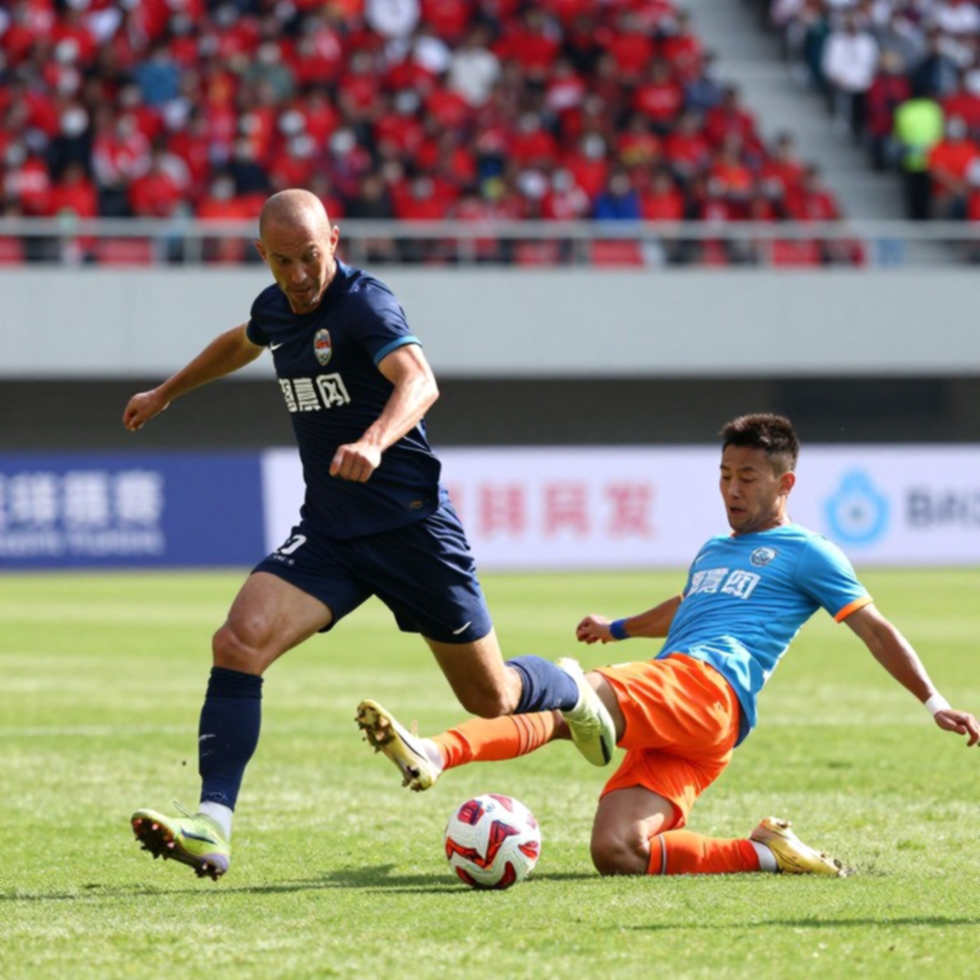
The tactical consequence is concrete. An old team cannot press high for ninety minutes, cannot repeatedly transition, cannot stretch the pitch to chase the ball. They must sit in a low block, stay compact, hold their distances and hope. That is not a choice — it is a consequence of squad construction. And when you sit in a low block against a side built to circulate the ball quickly, you hand the opponent exactly what they do best: time on the ball, space in both channels, and one-on-one situations at the edge of the box.
On the other side, Hanoi Police are not a side with a fixed attacking system aimed at a single target man. Their attacking unit — Alan Sebastiao, Leo Artur, Perea Vargas, Dinh Bac — suggests wide-to-central combination play, positional rotation, overloading a flank and then returning the ball into the second line. That matches the domestic phrase "fast ball circulation", and it is also the attacking style that hurts a back line that has just lost its anchor centre-back.
And here is the seam. Jovic Filip's suspension does not merely remove a starter — it removes the ability to organise the defence. In a low-block system, a centre-back is not just a clearer of balls; he is the man who sets the distances, decides when to step and when to drop, and assigns markers when the ball switches sides. Replacing a centre-back inside an already slow back line that is being pinned back is replacing a control unit, not a mechanical part. If Hanoi Police score in the first half, the match is effectively closed at that moment.
Single-point dependency: Cong Phuong and the age-31 trap
Dong Nai FC's attacking route funnels into one point: Cong Phuong. He is the squad's most anticipated name, and also the player who has left little impression across the opening two matches. At 31, his individual peak is behind him, and that is not a moral judgment — it is biological data.
There is a principle in squad analysis that English football calls single-point dependency risk. When a team has one creative source, the opponent does not need to shut down the whole team — they need to shut down one man. Hanoi Police have more than enough personnel to man-mark a single forward for ninety minutes, especially when that forward's team has no meaningful second option. Dong Nai FC's most natural alternative was a different focal point — Majdevac. Majdevac is injured. The buffer is gone.
This raises a structural question more important than the form question: how is this promoted club built to survive? If the answer is "through the individual moments of a 31-year-old", that is not a plan — it is a hope. And hope is not a structure; it is an abandoned structure.
The detail that Cong Phuong may start on the bench deserves careful reading, because it supports two opposite explanations. First: the coaching staff are managing his physical load, using him in the second half once the opponent has tired. Second: the coaching staff do not rate him as important in the way the media do. Both carry dressing-room narrative risk for a team on a losing run, and both make the man-marking job easier for Hanoi Police.
The stronger club's strength: depth as a shield
Hanoi Police also have a suspension: Doan Van Hau. But this is the core difference between the two clubs, and it explains why this fixture reads as a mismatch rather than a contest. A club with many defensive alternatives can absorb the loss of a national-team full-back without changing how it plays. A club with no defensive alternatives cannot absorb the loss of a centre-back.
The difference is not the quality of the substitutes — it is whether the club has a structure to lean on when a player is missing. Hanoi Police have one. They have a ball-circulation system, pre-established positional relationships, and a head coach with continental experience who knows how to rotate when the calendar gets dense. Playing the V-League and the AFC Champions League Elite in parallel is a genuine burden — no Southeast Asian club gets through that schedule unscathed. But Hanoi Police have enough depth to turn that burden into a management issue rather than a crisis.
That is the definition of a top club: their crisis is a scheduling problem, their opponent's crisis is an existence problem.
The V-League picture: a market concentrated at the top
Placed in the broader V-League landscape, a pattern is visible. The heavyweights — Hanoi Police, The Cong - Viettel, Hong Linh Ha Tinh — occupy most of the leading group. Promoted clubs enter at the survival tier, with squads patched together from veteran signings and one star hope. This is a classic concentrated-at-the-top structure, and it carries a consequence few discuss: the gap between the top group and the relegation group is not narrowed by transfer spending, it is widened by academy quality and management competence.
Dong Nai FC are not disadvantaged because they are poor. They are disadvantaged because they built a squad optimised for a single season, and that approach creates no assets. A sustainably surviving club needs one of two things: an academy good enough to produce players with value, or a recruitment model that buys cheap and sells high. The current Dong Nai FC squad shows signs of neither.
The commercial angle also matters here. This fixture is being promoted around a reunion between two former internationals — one wearing the champion's shirt, one the symbol of the promoted side. The media heat of the match does not come from competitive balance; it comes from memory. That is how a league monetises itself when it has not yet produced competitive balance: it sells the past. In Merseyside there is an 18-year-old boy forever suspended between genius and curse. All of us have a boy like that — and leagues know it.
Where I could be wrong
A piece without this section is selling, not analysing. So where am I wrong?
First, the sample is two matches. Two matches do not make a trend; they make an anecdote. Dong Nai FC's zero points could reflect a weak team, or it could reflect a brutal opening schedule — and with both recent opponents in the strong group, the second possibility is not small. If so, the Hanoi Police game is the third instalment of a hard run, not evidence of a collapsing club.
Second, the 1-4 defeat to Gamba Osaka is the only quality signal about Hanoi Police at international level, and it is negative. There is a reading that inverts this entire article: Hanoi Police are tired, deflated by a heavy loss, and a team in that state tends to expose gaps in midfield during the first twenty minutes. If Dong Nai FC pick the right moment to funnel the ball into that zone, the "mismatch" script could become an uncomfortable evening.
Third, the "old squad" story is a convenient and possibly lazy read. Age is a collective metric; experience is an individual one. A veteran back line that positions itself well can neutralise pace, and in football positional defending sometimes beats energy defending. I have watched enough of these matches to know the underestimated side usually gets exactly one chance — and it usually arrives from a corner, not a rehearsed move.
Fourth, and most seriously: everything above is built without a single process metric. No expected goals, no pressing index, no passing map. When the pitch goes quiet and the noisy stands have gone home, I see what the packed stands never show me: the bare truth. Here, that truth has not been published. Every professional conclusion sits at inference level, and I call it inference, not conclusion.
What I am waiting to verify
I am not predicting a scoreline here, because a scoreline is something I do not control and something not worth predicting. I am setting out three verifiable propositions.
First: if Cong Phuong does not start, the probability of Dong Nai FC registering two or more shots in the first half is close to zero.
Second: if Hanoi Police score inside the first thirty minutes, the match ends as a contest right there, whatever the final scoreline turns out to be.
Third: the biggest seam in this match sits at the vacant centre-back position, and any Dong Nai FC goal conceded from a ball into the central corridor confirms it.
People call it a curse; I call it a sentence written by hurried hands. A promoted club signs players past their peak, loses its anchor centre-back to suspension, loses its target man to injury, and loads all its hope onto a 31-year-old — that is not fate. It is a chain of decisions, and that chain has names, dates and people accountable for it.
The notable thing is not the result of this match. The notable thing is that after matchday three of the V-League, we will know whether Dong Nai FC are paying for a brutal schedule or paying for a squad built without survival in mind. The difference between those two things is their entire season.